A recent article in the publication Mother Jones, tells the story about how the “Big Sugar” companies used Big Tobacco style tactics to make sure that government agencies would dismiss troubling health claims against their sugar products.
Compared to the tobacco companies, which knew for a fact that their products were deadly and spent billions of dollars trying to cover up that reality, the sugar industry had a relatively easy task. With the jury still out on sugar’s health effects, producers simply needed to make sure that the uncertainty lingered. But the goal was the same: to safeguard sales by creating a body of evidence companies could deploy to counter any unfavorable research.
This decades-long effort to stack the scientific deck is why, today, the USDA’s dietary guidelines only speak of sugar in vague generalities. (“Reduce the intake of calories from solid fats and added sugars.”) It’s why the FDA insists that sugar is “generally recognized as safe” despite considerable evidence suggesting otherwise. It’s why some scientists’ urgent calls for regulation of sugary products have been dead on arrival.
Research increasingly suggests that sugar and its nearly chemically identical product, HFCS (High Fructose Corn Syrup), may very well cause chronic diseases that kill hundreds of thousands of Americans every year, and that these chronic conditions would be far less prevalent if we significantly reduced our consumption of sugar.
Robert Lustig, a leading authority on pediatric obesity at the University of California San Francisco, made this case last February in the prestigious journal Nature. In an article titled “The Toxic Truth About Sugar,” Lustig and two colleagues observed that sucrose and HFCS are addictive in much the same way as cigarettes and alcohol, and that overconsumption of them is driving worldwide epidemics of obesity and type 2 diabetes (the type associated with obesity). Sugar-related diseases are costing America around $150 billion a year, the authors estimated, so federal health officials need to step up and consider regulating the stuff.
Fast foods and sugar addiction leads to obesity and British celebrity chef Jamie Oliver is starting a “Food Revolution” in the U.S. to change the obesity health problem we have.
Huntington, West Virginia has been listed by the Center for Disease Control (CDC) as the nation’s unhealthiest city and that is where Jamie is starting his campaign. Jamie encounters a lot of resistance by the locals and the school meal program managed by the USDA is a disaster but he is determined to overcome.
His show is a six-part TV series co-produced by Ryan Seacrest of American Idol fame and is on ABC Friday evenings. I encourage you to watch.
The Food Revolution website has a petition with a call to save cooking skills and improve school food. Jamie plans to present the petition to President Obama and the first lady to ask for support. The last I checked, over 164,000 had signed.
Jamie won the 2010 TEDPrize: www.tedprize.org/jamie-oliver
Jamie Oliver’s Wish “I wish for your help to create a strong, sustainable movement to educate every child about food, inspire families to cook again and empower people everywhere to fight obesity.”
Kathleen DesMaisons, PhD, was one of the speakers at the “Brain Repair” conference I attended last month. She is author of “Potatoes Not Prozac“, “The Sugar Addict’s Total Recovery Program” and others. She is the first person to receive a doctorate in addictive nutrition and has more than 30 years experience working in public health and nutrition.
Many people who suffer from sugar sensitivity don’t even know it and they continue to consume large quantities of sweets, breads, pasta, or alcohol. She says her research shows indulging in sugar highs should be treated much more seriously like heroin or alcohol dependency because sugar causes damage in various neurotransmitters just like those drugs and can eventually wreak your health and relationships.
Below are Dr. DesMaison’s seven steps that will free you from the Jekyll and Hyde Syndrome of sugar addiction.
7 Step Solution for Sugar Addiction
1. Eat breakfast with protein
2. Journal what you eat and how you feel
3. Eat three meals a day with protein (no more than 5 hours between meals)
4. Take the recommended vitamins and have a potato before bed
5. Shift from white foods to brown foods
6. Reduce or eliminate sugars
7. Create a new life
Users of mental health services are increasingly looking for treatment and life-style choices to replace or combine with the more traditional medication approach.
There are many accounts of how people are managing their own recovery partly by using some of the concepts behind the food and mood approach.
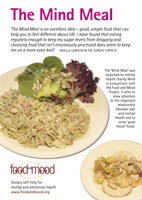
The “Mind Meal” aims to draw attention to the important relationship between food and mood and serves as an example of what can be done with some of the good mood foods that are generally recommended as beneficial for emotional and mental health.
The ingredients of the Mind Meal include foods with valuable vitamins, minerals and essential fats important for emotional and mental health. Also, what the Mind Meal doesn’t include is just as important as what it does contain.
A good “Mind Meal” includes:
* Good mood protein
Oil rich fish (salmon, sardines), nuts (walnuts) and seeds. Also includes avocados.
* Good mood carbohydrates
Eating meals with a low GI (Glycemic Index), which release their energy slowly and keep you feeling good for longer, also helps to avoid the roller coaster ride of energy and moods associated with large fluctuations in blood glucose levels. Green vegetables such as broccoli, spinach and green beans are great. Also legumes and some non-wheat pasta is good.
* Good mood fats
Polyunsaturated ‘omega 3’ fats are particularly important and these are particularly high in the oily rich fish and also present in pumpkin seeds and walnuts.
* Good mood vitamins and minerals Vitamins and minerals are essential for emotional and mental health. For example the conversion of tryptophan into the good mood brain chemical serotonin is helped by various ‘co-factor’ nutrients.
Do you crave sodas, chips, fries, pasta and similar foods? If so you are physically addicted! You no doubt have a chemical imbalance in your brain and body that causes you to crave these foods.
Julia Ross, MFT, author of “The Diet Cure” and “The Mood Cure”, and one of the pioneers in the field of nutritional psychology, offers various strategies to overcome these imbalances.
Julia has an eight part questionnaire that can help you solve your health condition.
1 – Is depleted brain chemistry the source of your cravings?
2 – Are you craving because of low-calorie dieting?
3 – Are your cravings due to stress or blood sugar instability?
4 – Do you have unrecognized low thyroid function?
5 – Are you addicted to foods you are actually allergic to?
6 – Are your hormones unbalanced?
7 – Do you have yeast overgrowth or parasites triggered by antibiotics, travel, or pets?
8 – Are you fatty-acid deficient?
Depending on how you score, Julia offers nutritional strategies that she has found can stop the cravings and help you obtain a biochemical balance.
Dr. Stephen Schoenthaler's research has shown that with good nutrition and supplements, violence and antisocial behaviors were greatly reduced in prisons and academic performance in schools increased. Learn more about his video presentation.
Professor Stephen Schoenthaler, PhD, began researching the relationship between nutrition and crime in 1980. He reported that institutional violence in Virginia had been cut in half after reducing the amount of sugar in the diet at no cost. By 1985, his research teams had successfully replicated such behavioral changes in 817 institutions in New York City, Los Angeles, and other locations within Virginia, Alabama, and California. These results included a 16 percentile improvement in English and Math scores among 1.1 million New York City schoolchildren and 48% reduction in juvenile violence among over 7,000 confined teenagers. Many of these childrens daily caloric intakes were over 25% sucrose, two and a half times above the World Health Organizations upper safety limit.
In 1985, Professor Schoenthaler’s teams discovered a link between high sugar intake and low vitamin and intake in juvenile and adult correctional facilities in New York, Florida, Oklahoma, and California. It appeared that a high sugar diet was displacing essential nutrients for good health. Even more startling, Professor Schoenthaler reported that low vitamin and mineral intake was linked with institutional violence. In fact, low intake was a better predictor of institutional violence than violence before incarceration.
In 1986, Professor Schoenthaler suspected that the reason why behavior improved on a low sugar diet was due to the increase in vitamins and minerals. To test this theory, his research teams gave vitamin-mineral supplements daily to confined offenders in Oklahoma and California and violence suddenly dropped in each facility between 37 and 43%. He realized that tablets and diet changes might be producing behavior changes due to psychological effects, the expectation that things might improve or the extra attention.
So in 1987, Professor Schoenthaler’s research team at California State University, Stanislaus decided to do a make-or-break test of the theory by conducting a randomized, controlled trial, the only type of research design the scientific community accepts as definitive. Confined Oklahoma teenage offenders were either given a course of vitamin-mineral tablets or fake dummy pills called placebos for three months and behavior, before and after, was measured using the institutions records of disciplinary actions. The results were clear cut. Offenders given supplements behaved significantly better than offenders given placebos. Among offenders with low initial concentrations of vitamins in their blood who were given vitamin-mineral tablets, violence fell over 90%.
Dry-drunk is a term used, often disparagingly, by members of Alcoholics Anonymous (AA) and by substance abuse counselors to describe the recovering alcoholic who is no longer drinking but who still demonstrates the same alcoholic behaviors and attitudes. Studies have shown that up to 90% of alcoholics are hypoglycemic (low blood sugar).
Get rid of white sugar, white flour, white rice, and white oils to help keep your blood sugar under control and maintain a biochemical balance within the brain according to Michael Lesser, M.D., a nutritional psychiatrist and author of The Brain Chemistry Plan. He is one of the pioneers in the development of orthomolecular psychiatry and medicine.
We are a participant in the Amazon Services LLC Associates Program, an affiliate advertising program designed to provide a means for us to earn fees by linking to Amazon.com and affiliated sites.
 Fast foods and sugar addiction leads to obesity and British celebrity chef Jamie Oliver is starting a “Food Revolution” in the U.S. to change the obesity health problem we have.
 Kathleen DesMaisons, PhD, was one of the speakers at the “Brain Repair” conference I attended last month. She is author of “Potatoes Not Prozac“, “The Sugar Addict’s Total Recovery Program” and others. She is the first person to receive a doctorate in addictive nutrition and has more than 30 years experience working in public health and nutrition.
 Users of mental health services are increasingly looking for treatment and life-style choices to replace or combine with the more traditional medication approach.
  Julia Ross, MFT, author of “The Diet Cure” and “The Mood Cure”, and one of the pioneers in the field of nutritional psychology, offers various strategies to overcome these imbalances.