Entries from April 2008
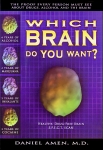 The proof every person must see about drugs, alcohol and the brain!
SEE FOR YOURSELF on DVD how drugs and alcohol damage your brain . . .
Meet five young people from different backgrounds, with different levels of substance abuse, including two who chose to stay clear of drugs or alcohol.
Hear their stories and learn about the impact their choices have had on the quality of their lives.
Next, look at the scans of their brains. See for yourself how their choices; good or bad; have affected the health of their brains.
The candid conversations between these young people and Dr. Daniel Amen, a pioneer in the use of brain scans, are revealing. They want to know if it’s too late . . . and they want another chance . . . now that they realize they DO have a choice.
The question echoes in their ears . . . Which Brain Do You Want?
This powerful, high-energy production includes . . .
* How the brain works
* How the brain is involved in everything you do
* What happens when the brain “misfires”
* The physical impact of drugs and alcohol on brain function
* How to improve your brain
I have this DVD and it is . . .
A MUST-SEE FOR PARENTS AND TEACHERS WHO WANT TEENS TO KNOW THE TRUTH ABOUT DRUGS AND ALCOHOL!
[Read more →]
Tags: Drugs and Brain Disorders
It compares normal brain images to abnormal brain images and looks at functional neuroanatomy.
[Read more →]
Tags: Drugs and Brain Disorders
Comparisons of normal brain images and brains that have been affected by alcohol and drugs.
[Read more →]
Tags: Drugs and Brain Disorders
 Studies have shown that people who take prescriptions for an anxiety disorder don’t get much help from it. And doctors have no definitive way to predict who will, and who won’t, benefit from each anti-anxiety prescription they write.
You are like a medical experiment or guinea pig.
K. Luan Phan, M.D., University of Michigan Medical School researcher, and his team are working to bring more certainty to how doctors and patients choose anxiety treatments, by probing the connection between brain activity, genetics and medication. According to the Journal of Neuroscience, he is reporting intriguing findings from brain imaging studies with marijuana users and making comparisons with prescription drugs such as Zoloft.
Dr. Phan notes that some individuals may be using illicit drugs and misusing prescribed drugs to alleviate their anxiety.
Wow – what a revelation! I call this self medication.
[Read more →]
Tags: Drugs and Brain Disorders
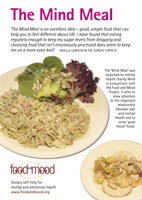 Users of mental health services are increasingly looking for treatment and life-style choices to replace or combine with the more traditional medication approach.
There are many accounts of how people are managing their own recovery partly by using some of the concepts behind the food and mood approach.
The “Mind Meal” aims to draw attention to the important relationship between food and mood and serves as an example of what can be done with some of the good mood foods that are generally recommended as beneficial for emotional and mental health.
The ingredients of the Mind Meal include foods with valuable vitamins, minerals and essential fats important for emotional and mental health. Also, what the Mind Meal doesn’t include is just as important as what it does contain.
A good “Mind Meal” includes:
* Good mood protein
Oil rich fish (salmon, sardines), nuts (walnuts) and seeds. Also includes avocados.
* Good mood carbohydrates
Eating meals with a low GI (Glycemic Index), which release their energy slowly and keep you feeling good for longer, also helps to avoid the roller coaster ride of energy and moods associated with large fluctuations in blood glucose levels. Green vegetables such as broccoli, spinach and green beans are great. Also legumes and some non-wheat pasta is good.
* Good mood fats
Polyunsaturated ‘omega 3’ fats are particularly important and these are particularly high in the oily rich fish and also present in pumpkin seeds and walnuts.
* Good mood vitamins and minerals
Vitamins and minerals are essential for emotional and mental health. For example the conversion of tryptophan into the good mood brain chemical serotonin is helped by various ‘co-factor’ nutrients.
The “Mind Meal” DOES NOT contain:
[Read more →]
Tags: Sugar Addiction
 For much of his adult life, Robert Downey Jr., 43, was caught in a ruinous cycle of drug addiction, imprisonment and disgrace. (This post has excerpts from an article in Parade Magazine)
Raised in a show-business family, Downey claims that by 8 he already had used drugs with his dad, a filmmaker.
“I was mercurial and recklessly undisciplined and, for the most part, I was happily anesthetized.”
“You use whatever rationalization you can to justify the fact that you’re not living truthfully,” he observes about substance abuse. “You make this death machine seem glamorous so you can get on to the next moment. But it isn’t glamorous, and it isn’t fun.”
“Now it’s all about becoming rooted in the mundane, in the day-to-day stuff,” he continues. “Life is 70% maintenance. I think of myself as a shopkeeper or a beekeeper. I’m learning the business of building a life.”
“Instead of getting instant gratification by getting high, I push my nose as far into the grindstone as I can. The honey, the reward, is the feeling of well-being, the continuity, the sense that I am walking toward a place I want to go.”
[Read more →]
Tags: Drug Abuse
 Corporate financing can have subtle effects on research and lead to bias. Studies have shown that sponsored research tends to reach conclusions that favor the sponsor, which is why disclosure is encouraged. The tobacco industry has a long history of underwriting research, sometimes through independent-sounding foundations, to make cigarettes seem less dangerous.
In October 2006, Dr. Claudia Henschke of Weill Cornell Medical College jolted the cancer world with a study saying that 80 percent of lung cancer deaths could be prevented through widespread use of CT scans.
Small print at the end of the study, published in The New England Journal of Medicine, noted that it had been financed in part by a little-known charity called the Foundation for Lung Cancer: Early Detection, Prevention & Treatment. A review of tax records by The New York Times shows that the foundation was underwritten almost entirely by $3.6 million in grants from the parent company of the Liggett Group, maker of Liggett Select, Eve, Grand Prix, Quest and Pyramid cigarette brands.
[Read more →]
Tags: Smoking - Nicotine Addiction
David Sheff, author of the book, Beautiful Boy, was a guest on the Oprah show this week. About half way through the program where they are discussing drug treatment programs, Oprah states that “relapse is a part of the treatment” and David Sheff concurs.
This is not true!
Relapse does not have to be a part of treatment in recovery but this is what most people believe.
When I read the book, I could see where the author had spent a lot of time and research trying to get answers to help solve his son’s drug addiction. Unfortunately he did not find the right people who had the answers.
My research shows that most drug treatment centers have a low success rate of 25% or less but it is possible to have success rates above 75% using methods that address the whole person – body, mind and spirit. This is where conventional treatment programs fail.
Some of the resources that people should review are:
[Read more →]
Tags: Drug Addiction Alternative Treatment
 The book, Beautiful Boy, by David Sheff, is a heartbreaking and wrenching story of a father’s journey through his son’s drug addiction. He states that he was addicted to his son’s addiction. Any parent who has had a child abuse drugs will be able to identify with this story.
I know I did. Even though my son did not use Meth (thank God) and did not disappear for weeks at a time on the streets, there were still many anxious moments wondering if he was OK.
David Sheff mentions early on how he confronted his son, Nic, about smoking Pot (Marijuana) and at first Nic lies and denies it. Then Nic admits that he is using some drugs “like everyone,” “just pot,” and only “once in a while.”
Over time, Nic gets more and more involved in using drugs including Meth and is in and out of rehab several times. Nic is in denial that he is an addict.
In recovery, Nic Sheff states that “a using addict cannot trust his own brain – it lies, says, ‘You can have one drink, a joint, a single line, just one.'” Nic learned that he could not trust his own brain.
[Read more →]
Tags: Drug Abuse
 Street drugs such as heroin or crack cocaine are more likely to be used by the poor, whereas prescription drugs are more likely used by the rich.
Actor Heath Ledger died from ‘acute intoxication’ caused by an overdose of prescription drugs. Other celebrities have also been in the spotlight news such as Rush Limbaugh, Britney Spears, and Lindsay Lohan.
It has been reported that the misuse of prescriptions leads to prescription drugs addiction and now kills more Americans than illegal street drugs, approximately 20,000 a year, which is double 10 years ago.
According to the 2006 National Survey on Drug Use and Health about teenagers aged 12-17, prescription drugs are second only to marijuana in popularity, and in the past 15 years there has been a 140 per cent increase in abuse. It is the fastest-growing type of drug abuse in the US.
[Read more →]
Tags: Prescription Drugs Addiction